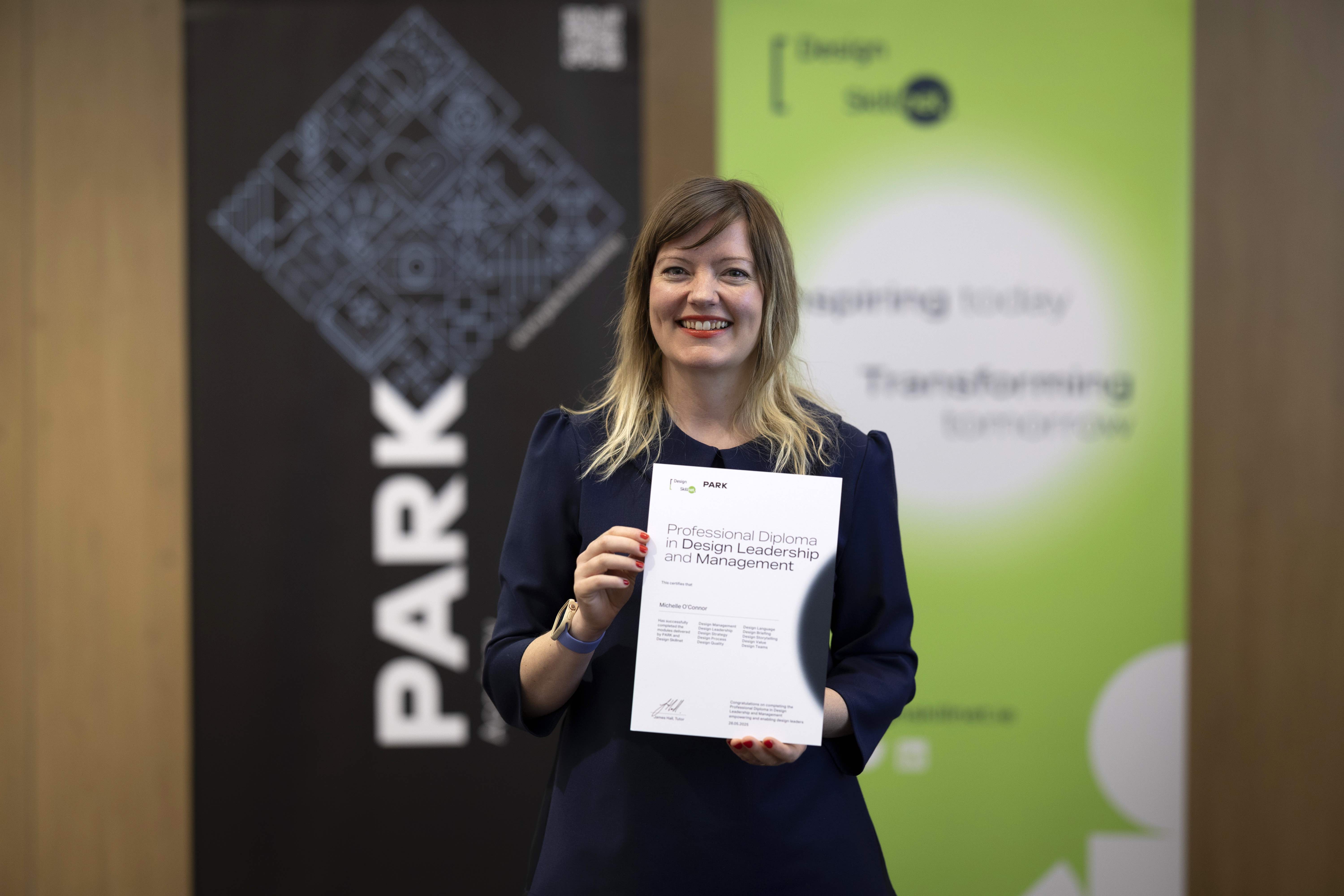
Michelle O’Connor, UX Designer at Laya Healthcare, blends her background in science, design and technology to craft thoughtful digital experiences that put users first. A graduate of the Professional Diploma in Design Leadership and Management, Michelle shares how the programme helped her shift from delivering great design work to leading with confidence — advocating for how design drives business value and collaboration across a large organisation.
“The Diploma helped me see design not just as delivery — but as a strategic function that can drive real business value.”
- Tell us a bit about your journey as a designer — from motion design to UX/UI. What led you to your current role at Laya?
I started my career with an undergraduate degree in Experimental Physics from NUI Galway. While I was drawn to the theory and mathematics, I felt something was missing creatively. This led me to complete a year-long FÁS course in Multimedia, where I discovered a passion for the intersection of design and technology.
I started out as a runner in a post-production company, but within two months, I joined the 2D visual effects graphics team, working on visuals for commercials and motion graphics for TV dramas. From there, I moved into graphic design, creating print materials such as booklets and posters. However, I soon realised I was missing the technical challenge and returned to university to complete an MSc in Computer Science (Interactive Media) at UCC.
This propelled me into the world of front-end development, where I spent around seven years honing my coding skills for a Cork start up. During this time, UX/UI design began emerging as a discipline, and I found it to be the perfect blend of my creative and technical interests. I shifted my focus to UX/UI design, working on interfaces for smart TVs and US based theme park and resort apps.
I joined Laya in 2017 as a UX/UI designer, and since then I’ve taken on a broad range of design responsibilities—from building CMS pages and enhancing the members area to shaping the new era of internal systems within our web architecture. It’s been a dynamic and rewarding journey that continues to evolve.
- Working in a large organisation like Laya, what are the biggest challenges — and opportunities — for design?
I really believe there is an awareness of the importance of design within Laya. Since starting at Laya, I definitely feel that our attitude to design has progressed and the role of design plays a prominent part in our overall thinking. As designers we collaborate, work from our shared design systems and are given the scope to adopt modern design concepts.
- How has the Diploma helped you position design as a strategic function in your company?
Prior to the Diploma I was only familiar and competent with fulfilling UX/UI design requests; working with the core technology team and delivering software solutions that met user needs. However, since undertaking the Diploma I have started viewing my work more from a business and commerce perspective. Understanding how design can shape and inform business strategies has resulted in exposing me to a world of design-meets-business that I had previously taken for granted.
- What mindset or skill from the programme has had the biggest impact on your work and your organisation?
The greatest benefit for me was learning how to articulate and deliver information, whether formal or informal, to an audience in a captivating and engaging way. There is an art to creating a story and how you deliver it. I have been equipped with the tools and confidence to bring this to my work every single day.
- Which modules had the most impact for you and what you wanted to achieve?
For me, the most impactful modules were the most challenging ones: Design Strategy and Storytelling. Neither of these were in my comfort zone but with the coaching and guidance from James I was empowered to take up the challenge. Through some form of alchemy, they became my most productive and enjoyable modules.
- How have you implemented your learning from the Diploma into your work? What has been the impact?
The templates were incredibly helpful resources. I plan to retake them every year as I think they are a valuable tool in assessing the progress of myself and the design team.
However, the greatest learning I will take away is having the confidence and belief in myself. I can now prepare and facilitate Design Thinking workshops with a group of attendees, confidently set an agenda, organise brainstorming sessions and generate valuable outputs for the team. These outputs can then assist with aligning the design and product team with the strategy and influence stakeholders.
- Would you recommend the Professional Diploma in Design Leadership and Management — and why?
Without any doubt, I cannot recommend this Diploma enough. This was more than just sitting in a classroom reading notes from a board. It was engaging, dynamic and applicable to all aspects of design. The 1-2-1 coaching sessions were so focused on me as an individual that it felt as though it was a course tailored exactly to my needs. The course material was so diverse that it benefitted attendees from a broad range of design disciplines.
Find out more about the Professional Diploma in Design Leadership and Management and register your interest for the next intake.
Find out how Design Skillnet can help you become more creative, human-centred, and impactful within your organisation.